Sunday, October 21, 2007

Wednesday, October 3, 2007
On To Annapurna


Apparently the weather on the mountains has settled now, and the snow/landslides have stopped, so tomorrow my sherpa I set off on a trek around the Annapurna Circuit, which I am now aiming to complete within 18 days. The maximum altitude reached will be at the peak of Thorung La Pass, which at a height of 5416 metres above sea level stands as the highest publicly trekked mountain pass in the world. It's actually higher than the Mt Everest Base Camp, and has a realtive oxygen level of around 55% compared to sea level, so this bit will be taken a little slower.
I should (hopefully) be back in civilisation by about the 22nd or 23rd, so I will put up some photos and comments then. Wish me luck!
Tuesday, October 2, 2007
Kathmandu - waiting for the landslides to stop (!)

Thamel, the main tourist hub of Kathmandu, is full of interesting arts and crafts stores, separated only by an equivalent number of trekking stores, hostels and travel agents. This store seems to be packed all hours of the day, with demonstrations available on request.




This is a plate of delicious Nepali 'buff momos'. Like the Indians, Nepalese people don't eat cows (but mysteriously there are none in the streets here?), but they cleverly get around it by eating the equally tasty buffalo.

Today I was supposed to be setting off on a 20 day trek around the Annapurna Circuit, however some adverse weather and a series of landslides have put that plan on hold for a few days. That has given me some more time to enjoy Kathmandu, including holiday stuff like reading, eating, drinking, watching the cricket with the locals and sleeping in.


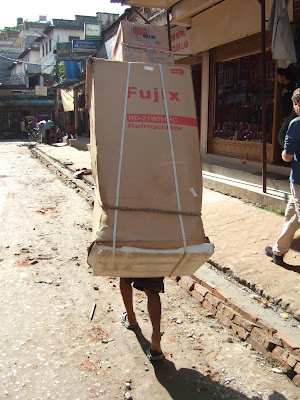
More goods are transported by people-power in Nepal than all other forms of freighting combined. This includes food, water, fuel, textiles, building materials, and in this case, a fridge.

Sunday, September 30, 2007
Catch Up Photos
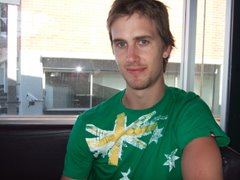
Captain Gore-Tex, ready for a mountain.

Downtown Kathmandu.

The road from the border to Kathmandu followed this river for about 4 hours.

Standard Nepalese landslide clean up operation.


Downtown Kathmandu.

The road from the border to Kathmandu followed this river for about 4 hours.

Standard Nepalese landslide clean up operation.

The surly Nepalese lady to my left was totally hogging the seat, so I ended up having a gearstick on my butt, which was less than comfortable given the number of gear changes required on these roads. It could've been worse though, the two guys on my right are sharing the drivers seat, and yes, one of them was driving. The driver is the one with the hash reefer on the far side.

Motorcycle anyone?

Public burning ghat on the Ganges River, Varanasi. The body is wrapped in gold foil at the water's edge.


Public burning ghat on the Ganges River, Varanasi. The body is wrapped in gold foil at the water's edge.

Saturday, September 29, 2007
Varanasi to Kathmandu
38 hours, 5 government buses (79 Indians, 1 Aussie per bus), 1 Mazda 121 (2 Indians, 2 Koreans, 3 Nepalese, 1 Aussie), 1 6 hour sleep in a train station waiting room, 1 suspiciously easy border crossing, 1 dodgy travel agent, 1 4WD (7 Indians, 4 Nepalese, 1 Aussie), 6941 near death experiences, 2 bottles of water, some deep fried somethings from the side of the road to eat, and some wicked body odour later, I made it to Kathmandu. Into a 2 hour traffic jam. It was awesome.
Wednesday, September 26, 2007
Varanasi, Uttar Pradesh
Nightime celebartion for Shiva on the waterfront.

'Autorickshaw'


'Autorickshaw'


Varanasi, the city of Shiva, is one of the holiest cities in India. Hindu pilgrims come from across the country to wash away their sins in The Ganges River, and it is regarded as the best place for a Hindu to die, as it offers a chance to escape the cycle of rebirth. The burning of dead bodies is an everyday occurence along the riverfront, with the creamtion process in full view of everyone, including me this morning. I don't think I'd ever seen a dead body before this morning, but today I saw 5, in various states of decomposition, washed up on the shore, metres away from others bathing and swimming.

The thing is, the whole place kind of smells like poo, which takes away from the holiness a touch. The smell isn't surprising though when you look at the stats on the river. Every day around 60,000 people take a dip along a 7km stretch of the river, with around 1.2 million people living within that area. Along this same distance, 30 sewerage outlets spew their contents into the river all day, every day. This results in the Ganges water being so polluted it is septic, ie no dissolved oxygen exists. Water samples from the river show that the river has 1.5 million faecal coliform bacteria per 100ml, compared to Sydney's reading at less than 500!

Agra to Varanasi

This leg was supposed to be easy. Leave Agra at 9:30pm to arrive in Varanasi at 9:30 am. I had my own bed with air conditioning and everything.

After enjoying a home-cooked dinner on the train platform with an Indian family, I boarded the train and fell asleep within an hour. I awoke to pouring rain, and the train standing still, in a vast green countryside that I had yet to see in India. Apparently we had been that way for 4 hours due to a tree falling over the tracks.
We arrived in Varanasi at around 4:30, making the trip a luxurious 19 hours in duration. The trip included 2 interesting meals, (no idea where they came from), and about 15 chai. 

Subscribe to:
Posts (Atom)